
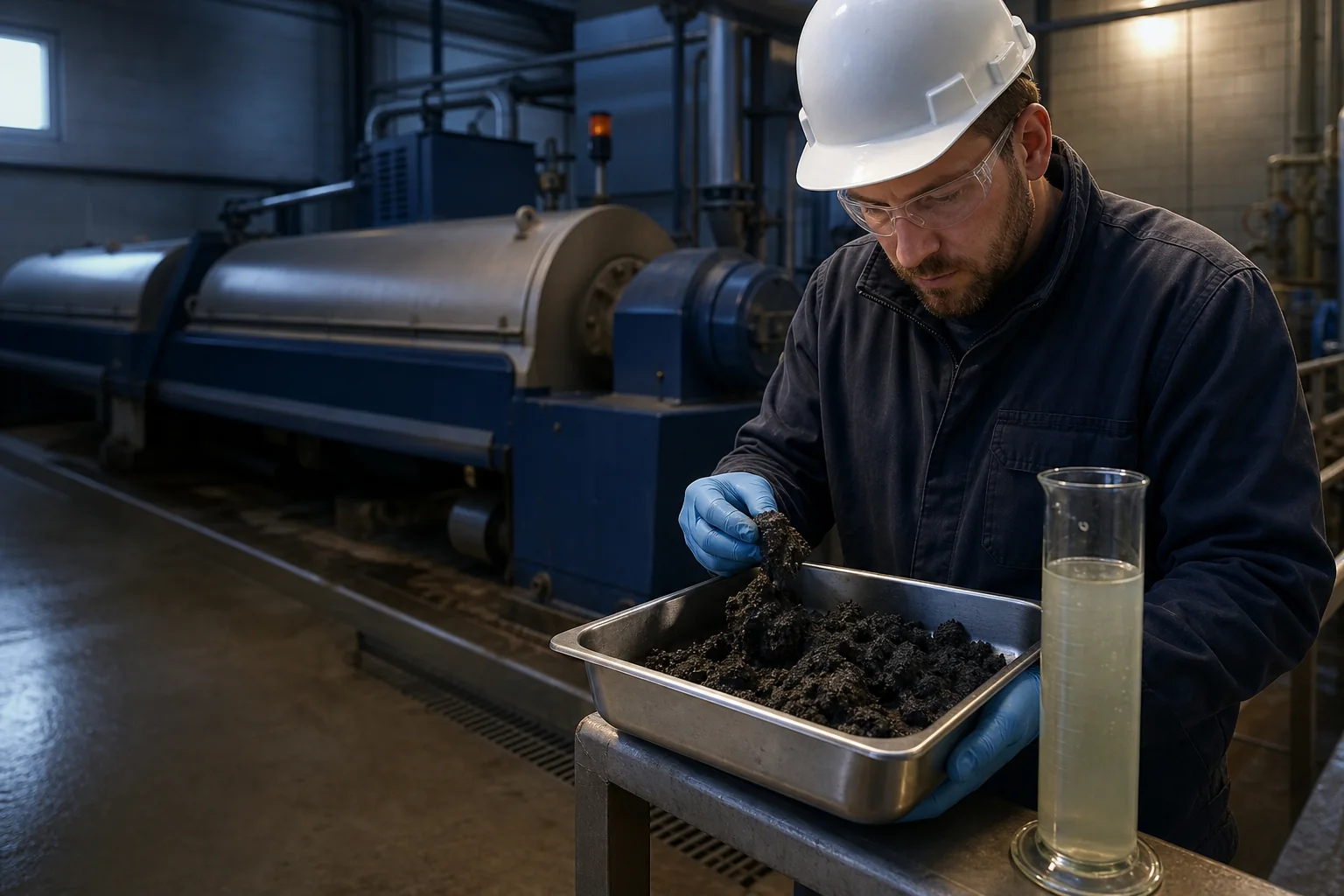
Cationic polyelectrolyte applications are best organized by the dewatering duty and machine response. The sludge supplies the charge demand; the equipment defines the shear, drainage, compression and residence conditions the conditioned floc must survive.
Use one feed record across equipment trials
Document sludge sources, blend ratio, solids, volatile fraction, pH, conductivity, temperature, storage and current chemicals. Collect samples at the actual conditioning point and record feed variation across the test period.
Normalize dose to active polymer per dry solids. Solution flow alone cannot be compared when stock concentration, sludge solids or process throughput changes.
Measure machine-specific endpoints
Centrifuges require matched data for centrate, solids capture, cake, torque and throughput. Belt presses require gravity drainage, filtrate, pressure-zone stability, cake release and belt cleanliness. Chamber presses require fill behavior, filtrate, pressure curve, cycle time and cake discharge.
Choose the endpoint that controls production and disposal rather than relying on a single visual test.
Build an operating window
Confirm underdose, stable operation and overdose. Then test normal and difficult feed. At full scale, change one input at a time and wait through the hydraulic and recycle delay before collecting a result.