
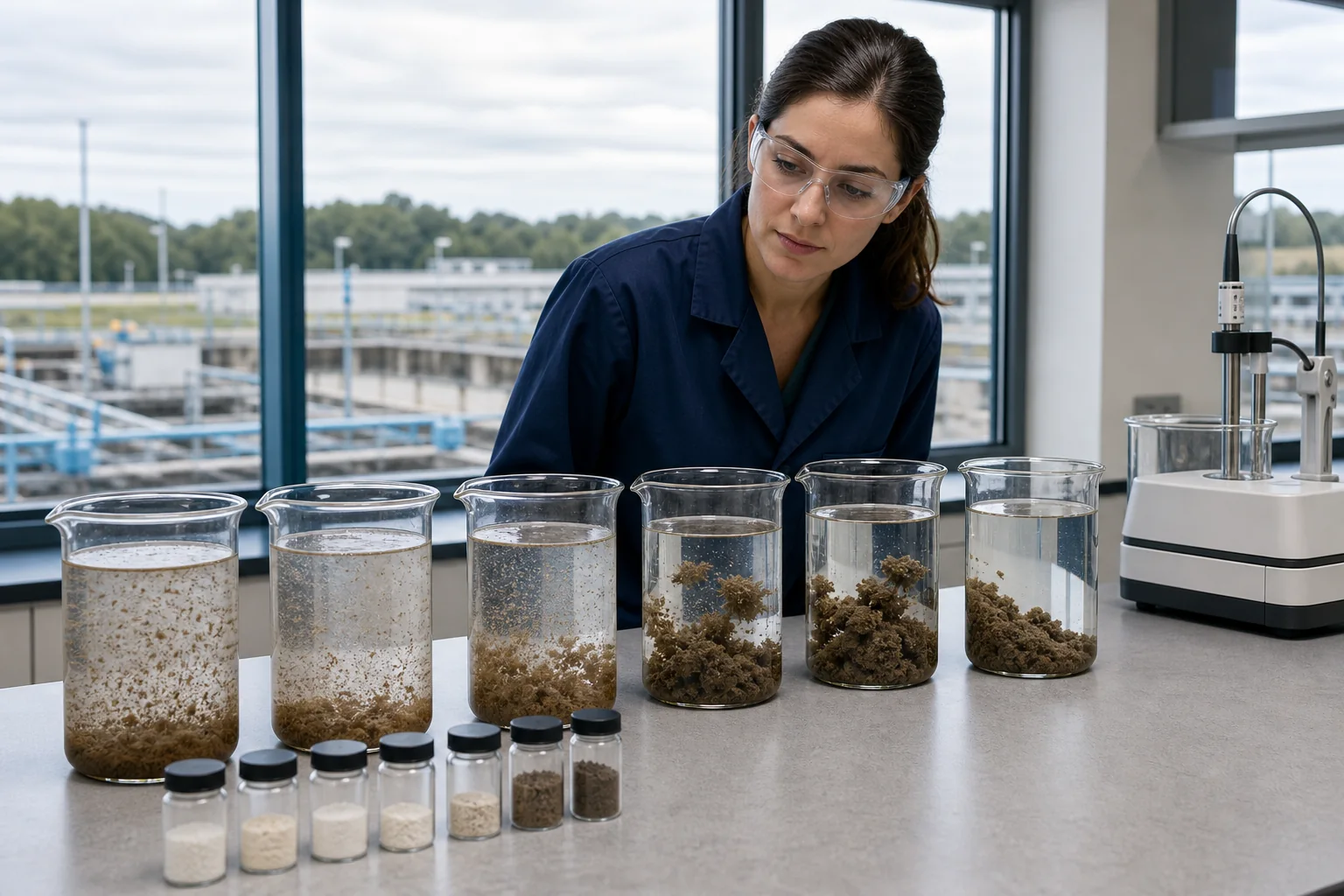
Cationic charge density influences adsorption and charge neutralization, but it does not select a sludge-dewatering product by itself. Molecular architecture, active dose, preparation, mixing and the dewatering machine determine whether the conditioned floc releases water and survives processing.
Define the charge-demand case
Record sludge source, blend ratio, dry and volatile solids, pH, conductivity, temperature, storage time and upstream iron, aluminium or lime. Biological age and soluble organic material can change polymer demand even when total solids appears stable.
Use representative normal and difficult sludge. Keep samples mixed gently and test promptly because settling, biological change and septicity can alter the result.
Choose adjacent candidates
Select low-to-medium, medium and higher-charge powder grades with molecular profiles close enough to make the charge effect interpretable. When molecular weight also changes substantially, treat it as a two-factor comparison rather than assigning the result entirely to charge.
Request the supplier method and reporting basis for cationicity or charge density. Values from different analytical methods may not be directly comparable.
Run equal-active-dose curves
Prepare each polymer using the same water, concentration, wetting, maturation and age. Compare equal active mass per dry solids. Include a blank, current product, underdose, useful middle points and a high-dose condition.
Measure free-water release, filtrate or centrate, solids capture, floc response after defined shear, cake solids and release. Avoid choosing by floc size alone.
Approve an operating band
Repeat the best conditions on fresh sludge and locate overdose. Select a middle dose that remains controllable through feed variation and feeder accuracy. Carry the exact grade, lot, preparation and endpoint into the plant trial.
Set acceptance limits before testing
For a charge-density screen, define the feed range, baseline treatment and decision before polymer is added. State which sample represents normal operation and which represents the difficult condition. A candidate cannot be ranked fairly if sludge composition or machine settings change during the comparison.
Use a measurable endpoint: filtrate or centrate, capture, cake solids, floc shear response and active treatment cost. Record the method, sampling delay and instrument condition. Include a practical constraint such as throughput, torque, pressure, wash water, cycle time or downstream recycle load.
Bracket expected feed variation
Build at least two cases around biological fraction, storage, volatile solids, pH and soluble organic demand. Run the same adjacent grades and active-dose steps on both. A broad controllable response is usually more useful than a narrow optimum on one easy sample.
Keep make-down water, concentration, wetting, maturation, solution age, dilution and mixing identical. If one condition must change, use a bridge comparison to separate the preparation effect from the sludge effect.
Read the full response curve
Plot blank, current product and candidate results against active dose per dry solids. Mark the first useful response, stable middle range and point where more addition stops helping or reverses performance. Repeat important middle and high points.
When higher charge lowers dose but creates sticky floc, a narrow window or weaker final dewatering, stop changing several variables together. Check sample integrity, upstream chemistry, stock solution, dose calculation, distribution and shear before moving to a different grade.
Carry the result into the machine
For scale-up, begin inside the repeated bench window while holding injection, dilution and machine settings fixed. Wait for the full equipment and recycle residence after each change. Collect matched feed, liquid and cake samples and preserve the machine settings with the result.
Convert pump or feeder settings back to active product use and reconcile with inventory during a stable period. Differences can expose calibration, tank turnover, dilution or recirculation errors.
Close the technical and purchasing record
Retain product code, lot, preparation sheet, dose curve, photographs, readings and full-scale result. Define the feed range and change condition that requires retesting so the approved sample remains connected to the material later received.
Request COA, TDS and SDS for the exact grade. Compare packaging, freight, storage, make-down, active consumption and dewatering value as delivered treatment cost.