
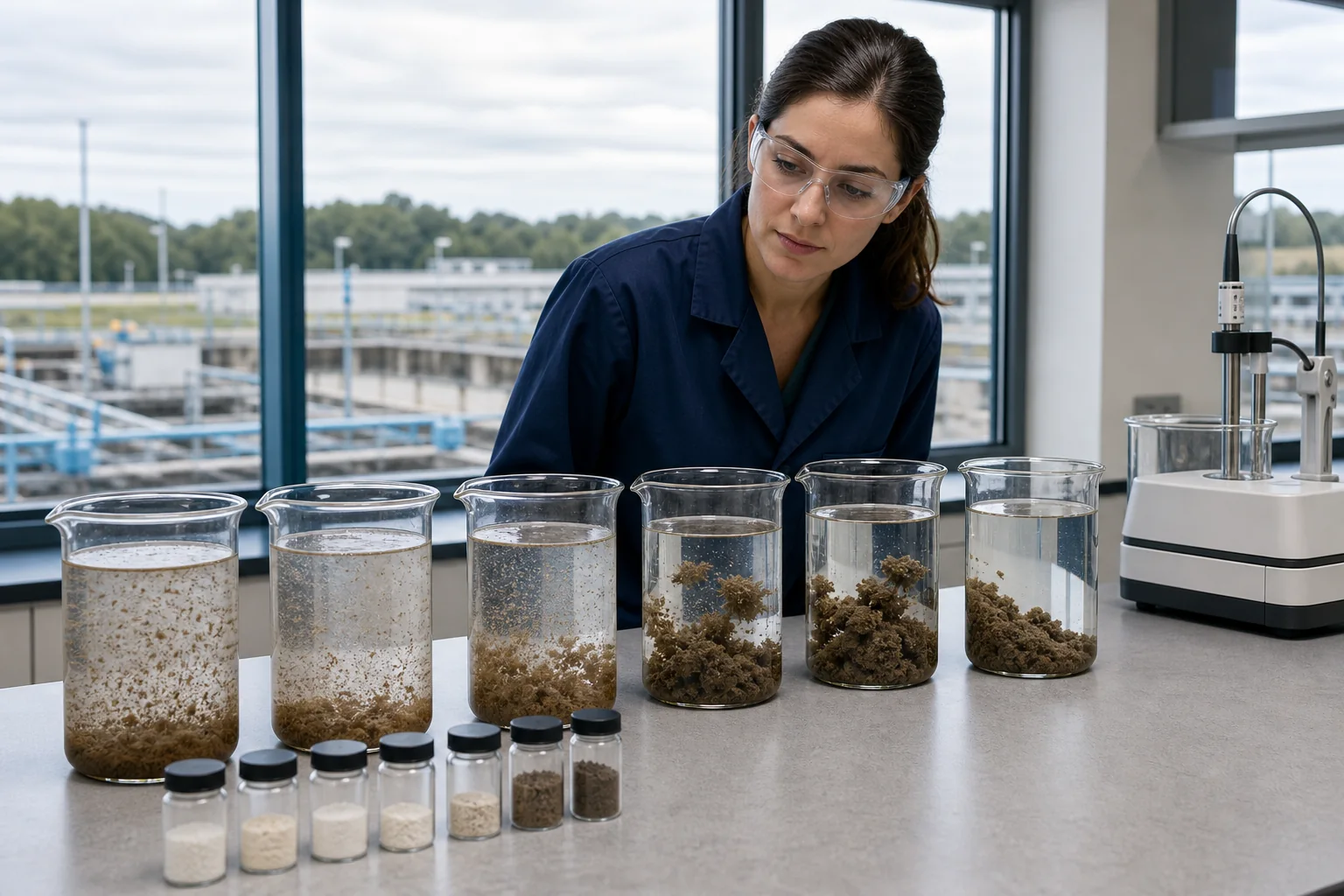
Cationic polyelectrolyte is a functional class, not one universal grade. For Xinqi powder products, the useful starting point combines cationic charge, molecular architecture, dissolution behavior, sludge chemistry and the mechanical duty that follows conditioning.
Separate charge demand from bridge length
Charge density influences how a positively charged polymer interacts with negatively charged biological solids, fine organic matter and colloids. Molecular weight and chain form influence bridging, floc size, shear response and water release. A higher value in either property is not automatically better.
Compare adjacent grades under the same active dose, solution preparation and mixing. Record centrate or filtrate quality, cake solids, capture, throughput and torque or pressure rather than ranking only visible floc size.
Use the equipment as part of the product definition
A decanter centrifuge applies acceleration and internal shear. A belt press needs early gravity drainage and a cake that remains permeable through compression. A chamber filter press needs conditioning that fills plates evenly, produces clear filtrate and releases cake after opening.
The same sludge can therefore select a different grade or dose when the dewatering machine changes. Identify feed point, dilution, residence and equipment settings before approving a commercial product.
Write a practical grade passport
Record grade code, lot, charge test method, viscosity or molecular indicator, active content, particle range, dissolution observation and preparation water. Attach the representative sludge test, dose window and equipment endpoint.
Begin with the cationic polyelectrolyte sample brief when the charge family is known but the exact grade is not.