
High-molecular-weight cationic polyelectrolyte can build larger bridges between conditioned solids, but longer chains also raise solution viscosity and distribution sensitivity. The grade must reach the particles before the equipment applies destructive shear or compression.
Audit make-down and delivery
Confirm powder wetting, active concentration, maturation, tank turnover, pump calibration and secondary dilution. Inspect for fisheyes and screen residue. A partially hydrated stock can look viscous while delivering much less active chain than expected.
Map high-speed pumps, narrow valves and recirculation. Compare laboratory stock with plant stock on the same sludge when field response is weaker than the bench result.
Match floc structure to the machine
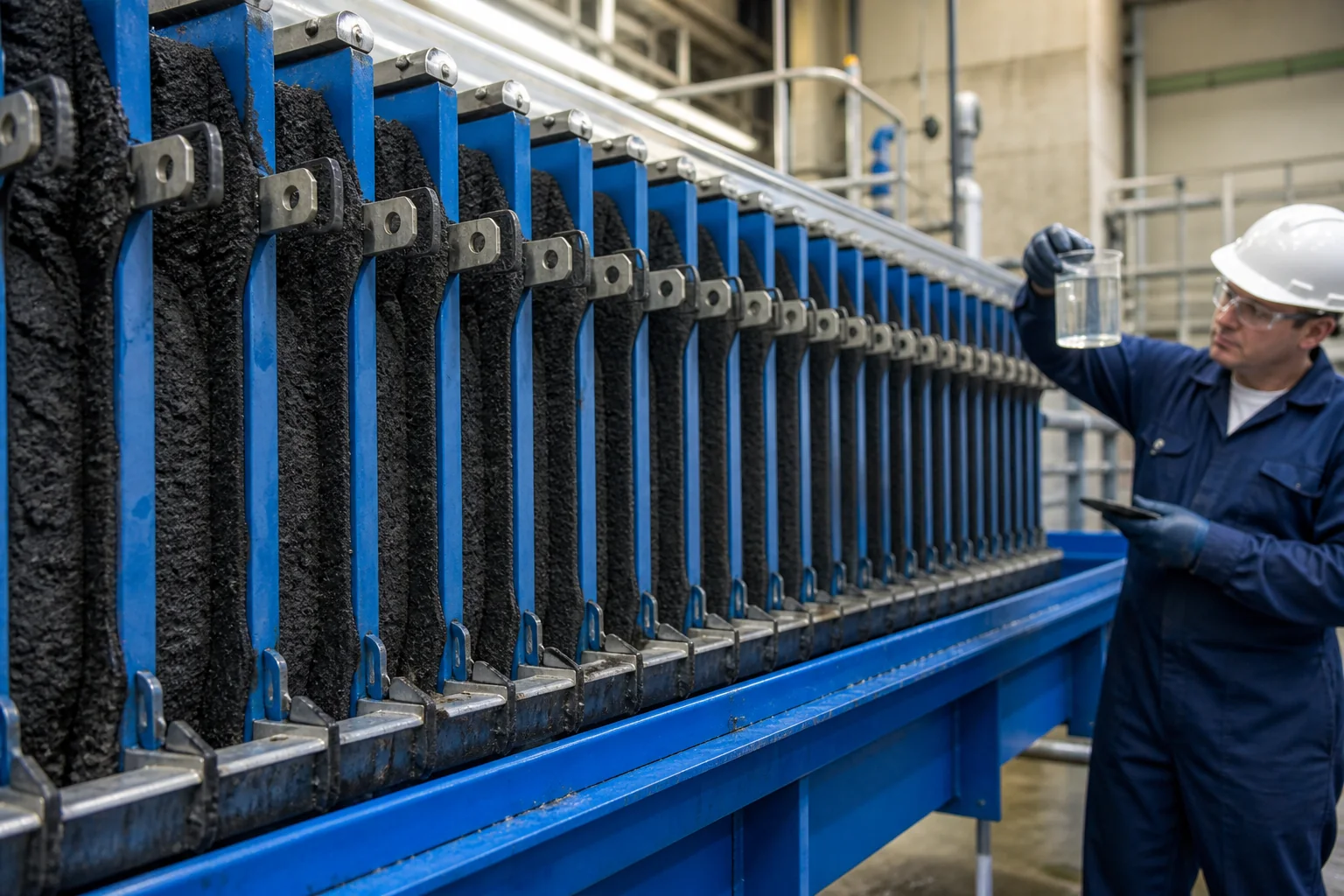
For centrifuges, test whether floc survives feed acceleration and produces acceptable centrate without excessive torque. For belt presses, observe initial drainage and cake permeability through pressure zones. For chamber presses, record filling, filtrate, pressure rise and release.
Very large floc is not automatically efficient. Elastic, water-rich aggregates can capture solids yet limit final dewatering.
Compare total process value
Measure active consumption, solids capture, cake solids, throughput, recycle quality and operator stability. Include wash-water and transport effects. Rank the product by the operating result it sustains, not by viscosity or nominal molecular weight alone.
Use the powder preparation procedure before rejecting a candidate for weak field performance.