
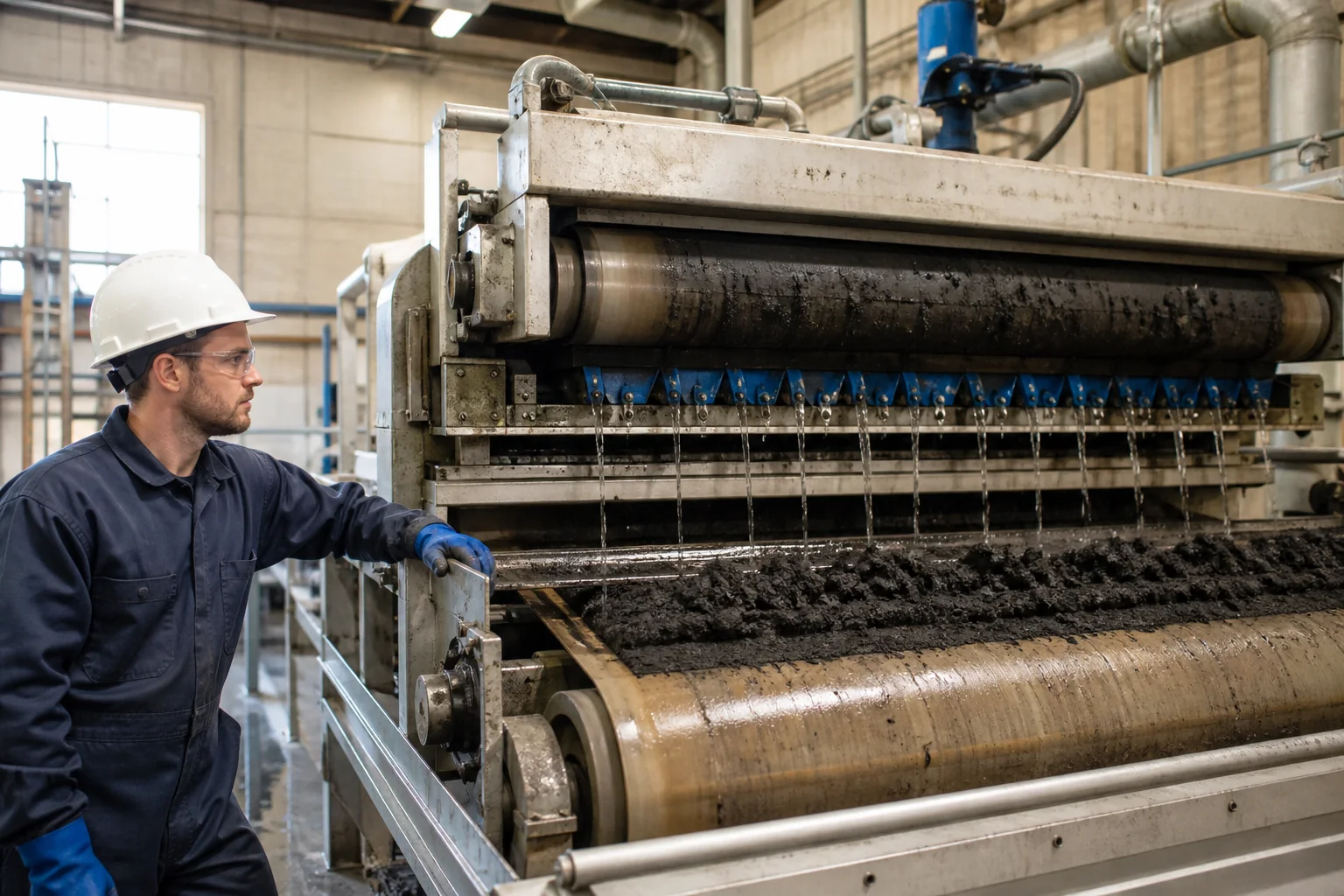
A belt press provides a visible sequence for cationic polyelectrolyte optimization. Follow the sludge from feed distribution through gravity drainage, wedge compression, pressure rollers and cake discharge instead of judging only the final cake.
Stabilize the mechanical baseline
Record feed solids and flow, belt speed, loading, tension, spray pressure, cloth condition and current polymer. Clean or document a fouled belt before testing because drainage loss can be mechanical rather than chemical.
Mark filtrate sampling locations and collect at consistent times. Early solids loss should not be diluted by clear wash water in the final sample.
Observe gravity drainage
Useful conditioning should release free water without allowing excessive fine solids through the belt. Record drainage distance, pool formation, filtrate and floc response to the first movement. Underdose can appear as slow drainage and dirty filtrate.
Overdose may create slimy floc, surface sealing or water-retaining cake. Test dose downward as well as upward.
Follow the cake into pressure
Observe lateral squeeze, belt tracking, cake breakage and filtrate as pressure increases. A large fragile floc may drain well initially but fail under compression. A dense elastic cake may capture solids while limiting final water release.
Measure cake solids, release and belt cleaning together with capture and throughput.
Optimize in two stages
First compare polymer grades and active dose with press settings fixed. Then adjust belt speed, loading or pressure around the selected condition. Allow the full press residence after each change and use matched feed and cake samples.
Select the setting that meets production, filtrate and disposal needs over a realistic feed range.
Set acceptance limits before testing
For a belt filter press trial, define the feed range, baseline treatment and decision before polymer is added. State which sample represents normal operation and which represents the difficult condition. A candidate cannot be ranked fairly if sludge composition or machine settings change during the comparison.
Use a measurable endpoint: gravity drainage, filtrate, cake solids, release, throughput and wash-water demand. Record the method, sampling delay and instrument condition. Include a practical constraint such as throughput, torque, pressure, wash water, cycle time or downstream recycle load.
Bracket expected feed variation
Build at least two cases around feed solids, loading, belt condition and biological-sludge composition. Run the same adjacent grades and active-dose steps on both. A broad controllable response is usually more useful than a narrow optimum on one easy sample.
Keep make-down water, concentration, wetting, maturation, solution age, dilution and mixing identical. If one condition must change, use a bridge comparison to separate the preparation effect from the sludge effect.
Read the full response curve
Plot blank, current product and candidate results against active dose per dry solids. Mark the first useful response, stable middle range and point where more addition stops helping or reverses performance. Repeat important middle and high points.
When early drainage improves but the pressure-zone cake seals, squeezes laterally or retains water, stop changing several variables together. Check sample integrity, upstream chemistry, stock solution, dose calculation, distribution and shear before moving to a different grade.
Carry the result into the machine
For scale-up, hold belt speed, tension and loading constant for the first grade and dose comparison. Wait for the full equipment and recycle residence after each change. Collect matched feed, liquid and cake samples and preserve the machine settings with the result.
Convert pump or feeder settings back to active product use and reconcile with inventory during a stable period. Differences can expose calibration, tank turnover, dilution or recirculation errors.
Close the technical and purchasing record
Retain product code, lot, preparation sheet, dose curve, photographs, readings and full-scale result. Define the feed range and change condition that requires retesting so the approved sample remains connected to the material later received.
Request COA, TDS and SDS for the exact grade. Compare packaging, freight, storage, make-down, active consumption and dewatering value as delivered treatment cost.