
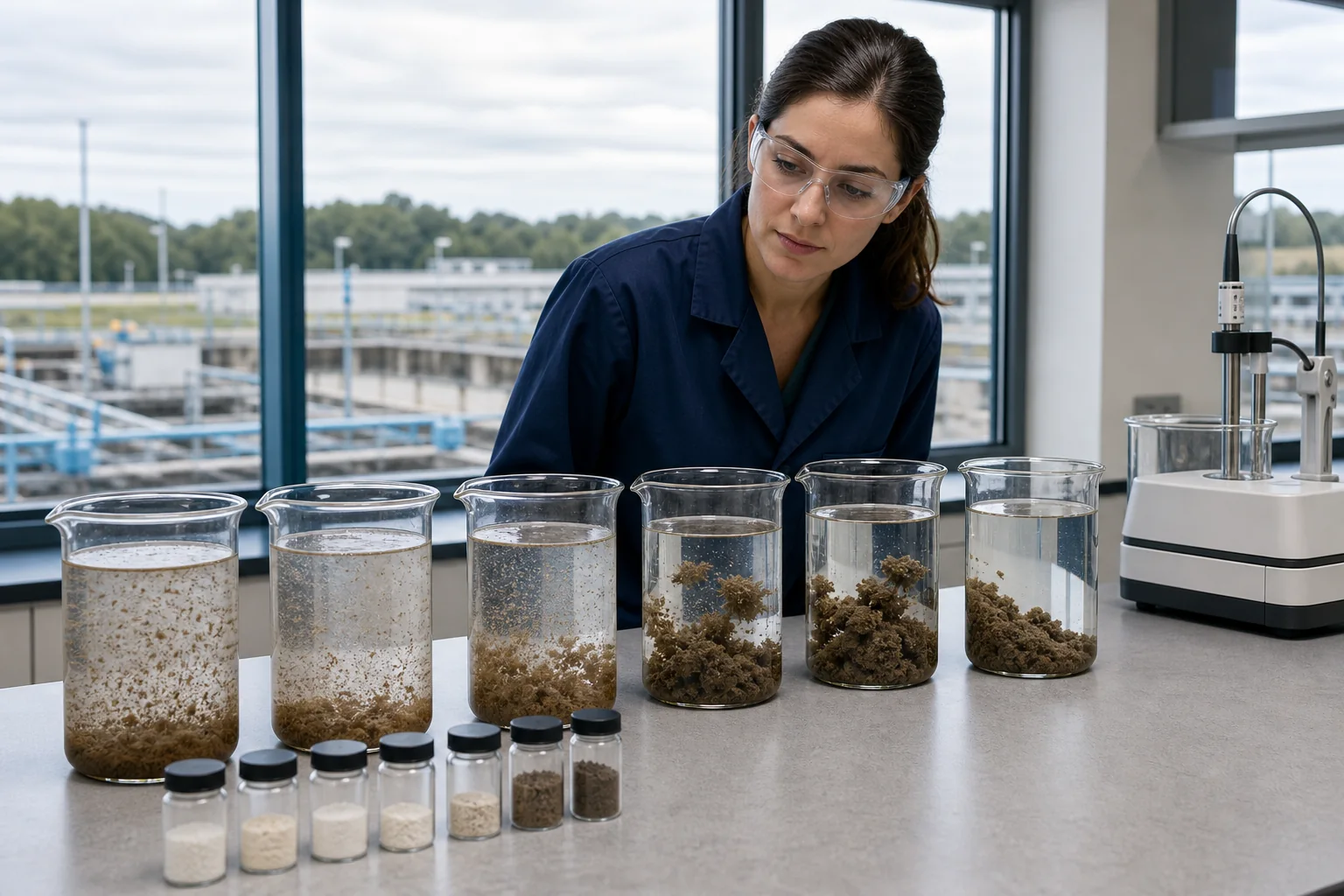
A medium-charge cationic polyelectrolyte is often a useful central candidate when mixed sludge needs both charge interaction and polymer bridging. The label describes a screening position; supplier methods and the actual sludge response still determine the result.
Define the feed envelope
Record primary-to-secondary sludge ratio, waste activated sludge age, volatile solids, dry solids, pH, conductivity, temperature, upstream coagulants and storage time. Septicity, biological composition and soluble extracellular material can change demand even when total solids remains stable.
Use fresh samples from normal and difficult operation. Homogenize gently before splitting tests so one cylinder does not receive settled grit while another receives only dilute supernatant.
Measure a complete dose curve
Compare active polymer per dry solids at several points around the first useful response. Observe free-water release, floc resilience after defined shear, filtrate or centrate, solids capture and cake behavior. Include an overdose point rather than assuming more polymer will keep improving the result.
For centrifuges, include torque, pond or differential settings during plant confirmation. For presses, include drainage time, pressure development, cake release and cloth condition.
Approve the middle of a controllable range
Choose a dose band that survives expected feed movement and feeder accuracy. A narrow laboratory optimum can be unstable in continuous service. Calculate delivered cost with polymer consumption, throughput, wash water, cake transport and recycle load.
Retain the approved sample and preparation record with the COA so subsequent lots can be compared on the same sludge and method.