
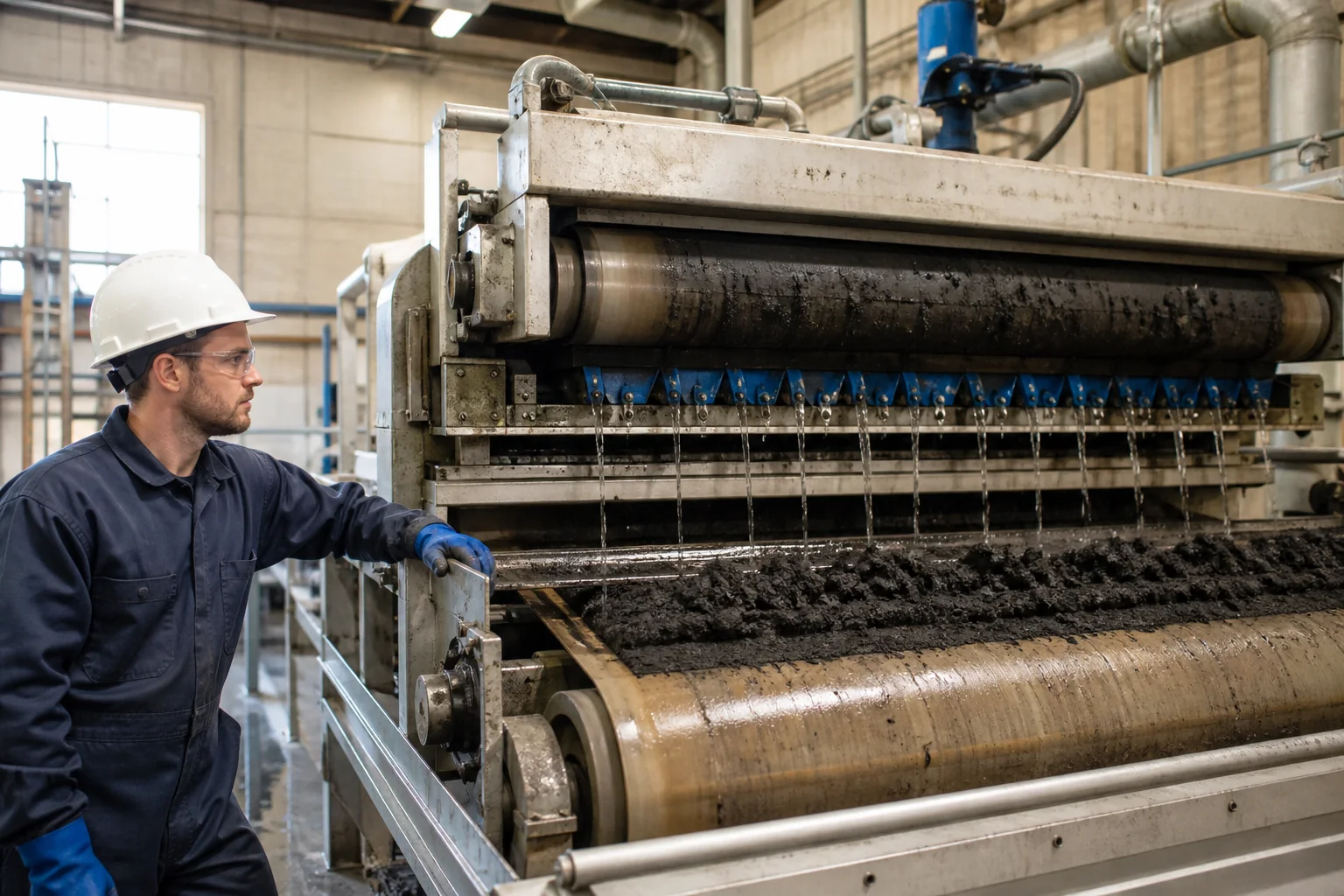
A belt filter press reveals conditioning quality before high pressure. Useful cationic polyelectrolyte should release water in the gravity zone, retain solids in the filtrate and form a permeable cake that survives wedge and pressure sections.
Read the press by zones
Record sludge feed, solids loading, belt speed, tension, wash water, gravity-zone drainage, wedge response, pressure-zone stability and cake discharge. Inspect cloth condition because fouling can imitate a polymer problem.
Collect filtrate from consistent locations and times. A clear final filtrate can hide poor early capture if samples are not matched to the process sequence.
Balance charge, bridge and permeability
Compare several active doses for adjacent grades. Underdose may produce slow drainage and solids loss. Overdose may form slimy or elastic floc, blind the belt, retain water or create sticky cake. The best visible floc may not create the driest or most releasable cake.
Include feed variation and repeat the selected conditions. Report active polymer per dry solids together with throughput and cake result.
Scale with the press held stable
Keep belt speed, loading, spray and pressure fixed for the first polymer comparison. Allow the full press residence after each dose change. Only after the polymer window is clear should mechanical settings be optimized around the selected condition.
Use the belt press optimization procedure to structure the trial.