
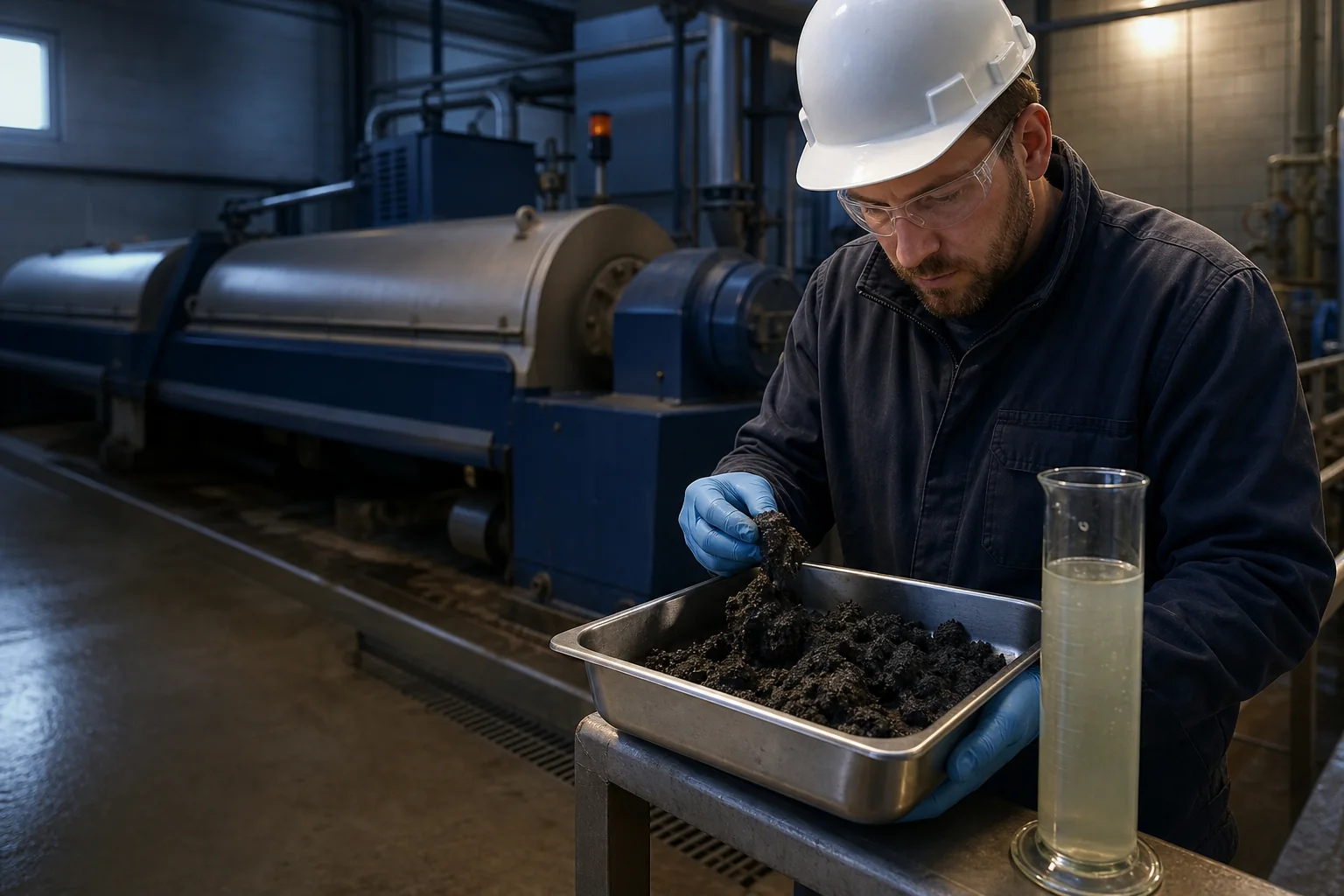
A decanter centrifuge combines rapid acceleration, internal transport and shear. The selected cationic polyelectrolyte must form floc quickly, distribute across the sludge and retain enough structure to separate without sacrificing cake dryness or machine stability.
Establish a machine baseline
Record feed solids and flow, bowl speed, differential speed, pond depth, torque, current polymer strength and pump output. Collect matched feed, centrate and cake samples after stable residence. A polymer trial cannot be interpreted when mechanical settings drift at the same time.
Calculate capture and cake solids with a consistent method. Include centrate recycle load where it affects upstream treatment.
Screen for charge and shear response
Use adjacent charge and molecular profiles at equal active dose. Apply a repeatable bench shear challenge, then measure free-water release and supernatant. The bench result narrows candidates; it does not reproduce the full centrifuge.
At plant scale, keep dilution and injection position visible. Poor distribution can create alternating underconditioned and sticky overdosed feed.
Run controlled machine steps
Start conservatively inside the repeated bench range. Hold the centrifuge settings, wait for stable discharge, then collect feed, centrate and cake. Adjust one polymer or mechanical variable per step and reconcile active use against inventory.