
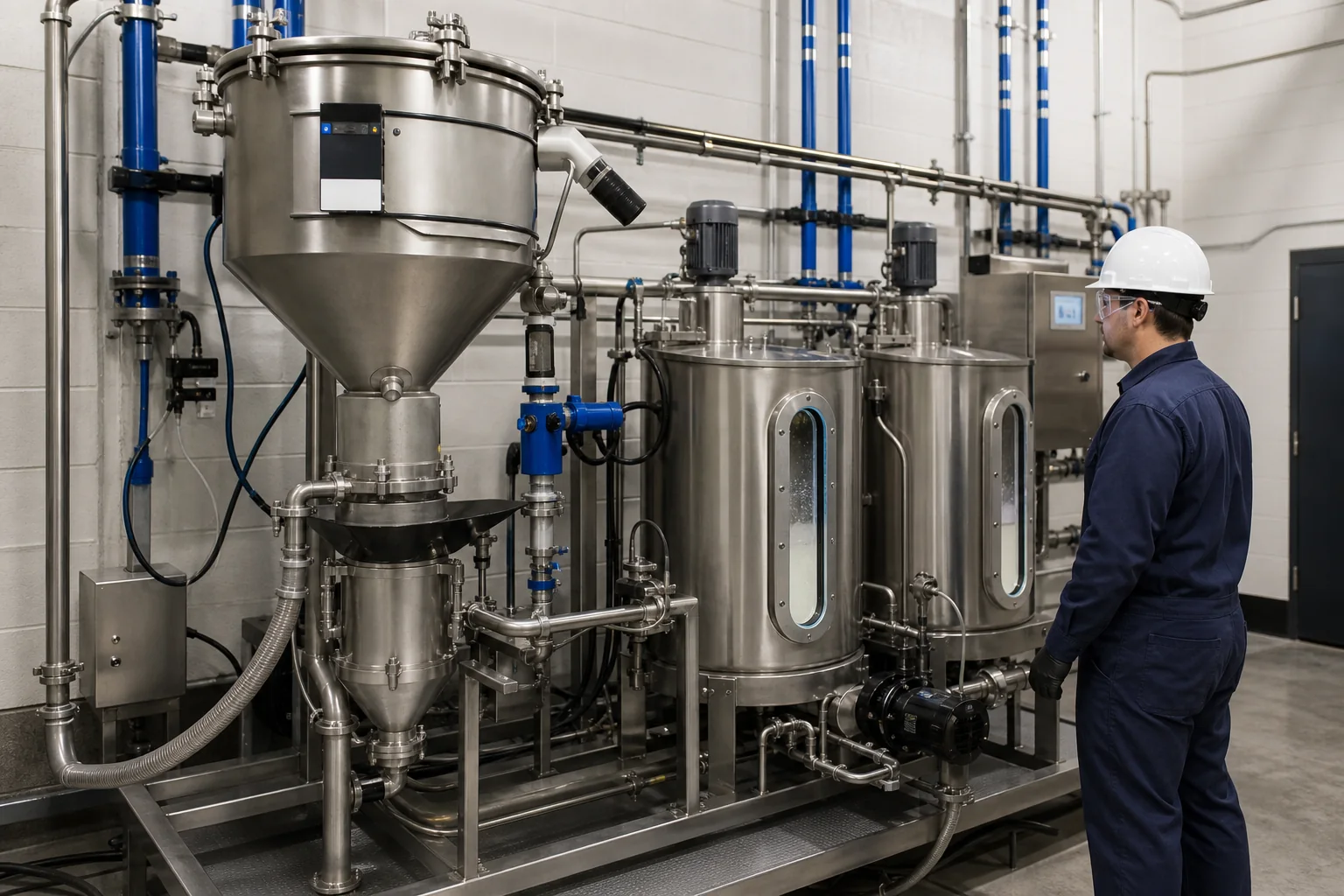
Cationic polyelectrolyte consumption should be compared on active polymer per dry solids. Pump percentage, litres of stock solution and product per cubic metre can conceal changes in stock strength, sludge solids or process flow.
Set the mass basis
Record commercial product mass, active or solids basis used, make-down water and final stock volume. For a powder product, state whether the calculation uses product as supplied or a corrected active fraction. Use one convention for every candidate.
Measure rather than assume feeder output and water flow. A recipe target is not the same as the concentration delivered by the plant skid.
Calculate active polymer flow
Multiply stock-solution mass flow by its active mass fraction. When only volumetric solution flow is known, use a measured or justified density. Secondary dilution changes delivery volume but does not change active polymer mass.
Keep units visible at every step. Convert hours, minutes, kilograms and grams before forming the final ratio.
Calculate dry-solids flow
Multiply sludge volumetric flow by sludge density and dry-solids mass fraction using compatible units. Confirm that the solids sample represents the same time and stream as the recorded flow. A grab sample during a feed surge can distort the result.
Divide active polymer mass flow by dry-solids mass flow and report kilograms per dry tonne or equivalent. Retain more digits during calculation than the feeder can control, then round the operating setpoint sensibly.
Reconcile calculation with use
Collect timed feeder or pump delivery at several settings and compare the calculated product use with bag inventory and tank depletion during stable operation. Differences commonly reveal calibration, short tank residence, recirculation or concentration error.
Attach cake, capture, throughput and recycle results to the active dose. Consumption without performance is not an optimization metric.
Set acceptance limits before testing
For an active-dose calculation, define the feed range, baseline treatment and decision before polymer is added. State which sample represents normal operation and which represents the difficult condition. A candidate cannot be ranked fairly if sludge composition or machine settings change during the comparison.
Use a measurable endpoint: kilograms active polymer per dry tonne tied to capture, cake solids and throughput. Record the method, sampling delay and instrument condition. Include a practical constraint such as throughput, torque, pressure, wash water, cycle time or downstream recycle load.
Bracket expected feed variation
Build at least two cases around minimum and maximum sludge flow, density, dry solids and stock concentration. Run the same adjacent grades and active-dose steps on both. A broad controllable response is usually more useful than a narrow optimum on one easy sample.
Keep make-down water, concentration, wetting, maturation, solution age, dilution and mixing identical. If one condition must change, use a bridge comparison to separate the preparation effect from the sludge effect.
Read the full response curve
Plot blank, current product and candidate results against active dose per dry solids. Mark the first useful response, stable middle range and point where more addition stops helping or reverses performance. Repeat important middle and high points.
When calculated use differs from timed feeder output, tank depletion or bag inventory, stop changing several variables together. Check sample integrity, upstream chemistry, stock solution, dose calculation, distribution and shear before moving to a different grade.
Carry the result into the machine
For scale-up, measure delivery under operating pressure and reconcile a mass balance across one stable shift. Wait for the full equipment and recycle residence after each change. Collect matched feed, liquid and cake samples and preserve the machine settings with the result.
Convert pump or feeder settings back to active product use and reconcile with inventory during a stable period. Differences can expose calibration, tank turnover, dilution or recirculation errors.
Close the technical and purchasing record
Retain product code, lot, preparation sheet, dose curve, photographs, readings and full-scale result. Define the feed range and change condition that requires retesting so the approved sample remains connected to the material later received.
Request COA, TDS and SDS for the exact grade. Compare packaging, freight, storage, make-down, active consumption and dewatering value as delivered treatment cost.