
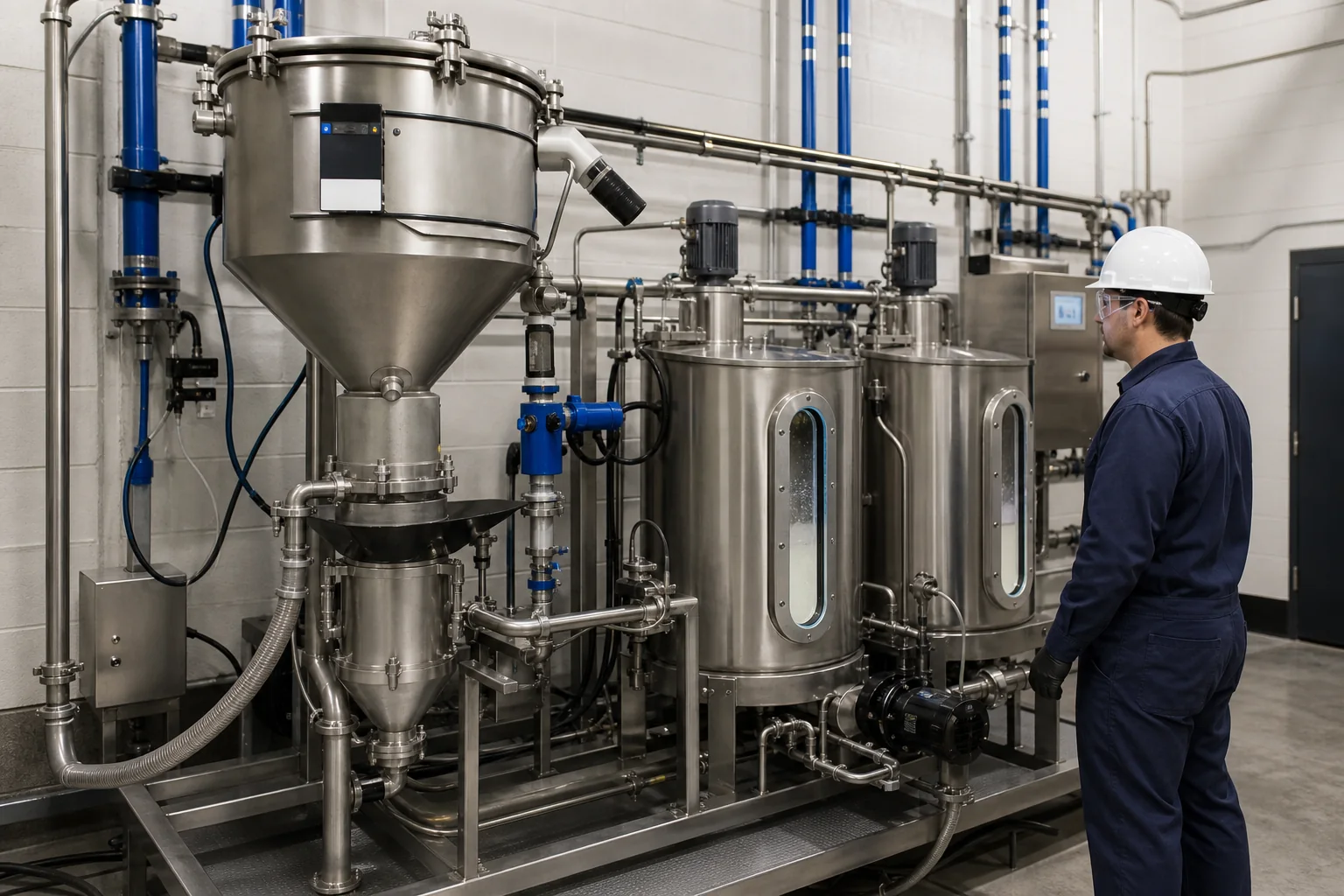
Powder cationic polyelectrolyte must wet, disperse and hydrate before it can be evaluated. Fisheyes, incomplete maturation, excessive concentration or transfer shear can make a suitable grade appear weak and can create erratic plant dose.
Control the make-down water
Record source, temperature, pH, conductivity and hardness. Compare laboratory and plant water when performance differs. Keep the hopper, feeder and storage area dry because premature moisture creates agglomeration and feed instability.
Follow the product SDS and plant procedure. Hydrated polymer on a floor is extremely slippery and requires controlled cleanup.
Induct powder gradually
Establish the designed water flow or vortex before feeding powder. Introduce it at a stable rate so individual particles wet without forming a surface raft or dense clumps. Do not dump an open bag into a stagnant tank.
Inspect the wetting cone, eductor and tank wall. Powder deposits or an unsteady feeder produce concentration pulses that continue through the dosing system.
Choose a workable concentration
Use a stock concentration that the mixer, transfer pump and dosing line can handle. Highly viscous stock may be fully hydrated yet distribute poorly into sludge. Apply secondary dilution near injection when it improves contact without changing active dose.
Document the active basis and include dilution water in any sensitive hydraulic balance.
Mature without damaging the chain
Provide enough initial movement for dispersion, then gentle agitation during hydration. Calculate actual residence from working volume and peak draw, not nameplate tank size. Prevent fresh stock from short-circuiting directly to the day tank outlet.
Inspect for fisheyes, screen residue and an unstable viscosity trend. Compare early and mature solution on the same sludge if residence is uncertain.
Verify transfer and delivery
Review high-speed pumps, narrow valves, recirculation and long aging. Calibrate solution flow against discharge pressure. Keep grade, lot, water, concentration, start time, maturation, tank level and test result in one operating record.
Set acceptance limits before testing
For a powder make-down audit, define the feed range, baseline treatment and decision before polymer is added. State which sample represents normal operation and which represents the difficult condition. A candidate cannot be ranked fairly if sludge composition or machine settings change during the comparison.
Use a measurable endpoint: fisheye-free stock, stable hydration, calibrated delivery and repeatable sludge response. Record the method, sampling delay and instrument condition. Include a practical constraint such as throughput, torque, pressure, wash water, cycle time or downstream recycle load.
Bracket expected feed variation
Build at least two cases around water temperature, feeder rate, working volume, peak demand and solution age. Run the same adjacent grades and active-dose steps on both. A broad controllable response is usually more useful than a narrow optimum on one easy sample.
Keep make-down water, concentration, wetting, maturation, solution age, dilution and mixing identical. If one condition must change, use a bridge comparison to separate the preparation effect from the sludge effect.
Read the full response curve
Plot blank, current product and candidate results against active dose per dry solids. Mark the first useful response, stable middle range and point where more addition stops helping or reverses performance. Repeat important middle and high points.
When laboratory stock works but plant stock does not, or response changes with tank level, stop changing several variables together. Check sample integrity, upstream chemistry, stock solution, dose calculation, distribution and shear before moving to a different grade.
Carry the result into the machine
For scale-up, correct induction, water and residence before comparing another grade. Wait for the full equipment and recycle residence after each change. Collect matched feed, liquid and cake samples and preserve the machine settings with the result.
Convert pump or feeder settings back to active product use and reconcile with inventory during a stable period. Differences can expose calibration, tank turnover, dilution or recirculation errors.
Close the technical and purchasing record
Retain product code, lot, preparation sheet, dose curve, photographs, readings and full-scale result. Define the feed range and change condition that requires retesting so the approved sample remains connected to the material later received.
Request COA, TDS and SDS for the exact grade. Compare packaging, freight, storage, make-down, active consumption and dewatering value as delivered treatment cost.